


 English
 русский
 Español
 Français
 عربى
عربى 简体中文
简体中文
Why Choose Pallet Mould Over Wooden Pallets?
2026-04-24
Wooden pallets crack under pressure, warp in humidity, and fall apart after a handful of load cycles — and when that happens on a production floor or inside a distribution center, the cost shows up immediately in damaged goods, delayed shipments, and replacement orders that were never budgeted for. If your operation depends on pallet performance and you are tired of treating fragility as an unavoidable variable, the conversation around Pallet Mould technology becomes relevant quickly. The core idea is not patching a material problem with better wood — it is replacing the structural logic of pallet manufacturing with one that engineering controls from the inside out.
Why Do Wooden Pallets Keep Failing?
Wooden pallets fail for reasons that are difficult to eliminate through better sourcing or maintenance alone. The material itself introduces variability that no manufacturing process fully corrects.
Common failure points in day-to-day industrial use:
- Load cracking: Concentrated pressure from forklift tines or uneven stacking causes boards to split along grain lines that vary from one piece of timber to the next.
- Moisture deformation: Wood absorbs humidity from warehouse floors, outdoor staging areas, and freight containers. Swelling, warping, and nail loosening follow almost inevitably.
- Decay and contamination: Organic material degrades over time, particularly in temperature-variable or high-moisture environments. In food and pharmaceutical supply chains, this creates compliance headaches that go well beyond the pallet itself.
- Nail fatigue: Repeated handling cycles loosen fasteners gradually. A pallet that passes inspection on Monday may fail under load by Thursday with no visible warning at all.
- Inconsistent load capacity: Because timber density and grain structure vary across boards, two pallets built to the same specification do not necessarily perform the same way under identical loads.
These are not quality control failures. They are structural properties of the material — and that distinction matters when you are deciding whether to fix the problem or work around it.
The Limits of Traditional Wooden Pallet Manufacturing
Improving wooden pallet production runs into a wall that better tooling and tighter specifications cannot get past.
- Natural defects: Knots, cracks, and density variation are inherent to wood. They cannot be graded out entirely without pushing material costs to a point where the economics break down.
- Manual assembly inconsistencies: Nailing patterns, board spacing, and joint alignment vary between workers, shifts, and production runs. That variation becomes structural variation in the finished pallet.
- Limited lifespan under industrial cycles: Wooden pallets in active rotation typically survive a fraction of the cycle count that engineered alternatives handle. Repair extends usable life but does not restore load capacity.
- Repair economics that work against the operation: Sorting, repairing, and returning damaged pallets to circulation costs labor and time. At a certain volume, the repair operation becomes its own logistics problem.
The ceiling on wooden pallet performance is set by the material. That is not a manufacturing opinion — it is just what wood does under sustained industrial stress.
Why the Industry Is Moving Toward Mold-Based Pallet Systems
The shift toward molded pallets comes from a straightforward engineering argument: when a pallet is produced from a precision mold, its structural properties are defined at the design stage — not determined by the batch of timber that happened to arrive that week.
What actually changes with this approach:
- Structural consistency across every unit: Each pallet from the same mold carries the same rib geometry, wall thickness, and load distribution characteristics. Variability disappears from the production equation.
- Material selection replaces material acceptance: Instead of working around whatever the timber supply delivers, molded pallet production starts with a specified polymer that behaves predictably under defined load and temperature conditions.
- Design intent becomes production reality: Engineers can specify exactly how load distributes across the pallet surface, where reinforcement belongs, and how forklift tine entry points should be structured — and those decisions get locked into the mold permanently.
How Precision Mold Design Defines Structural Performance
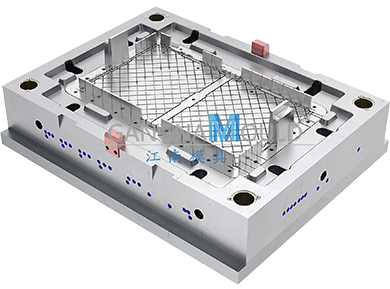
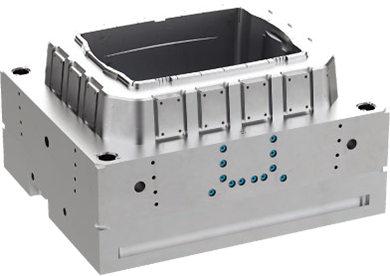
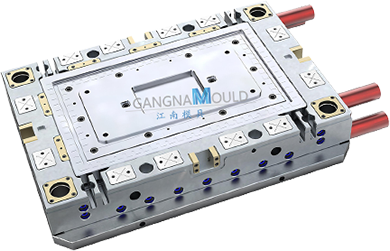
A Pallet Mould is the precision tooling system that shapes molten polymer into a finished pallet through an injection molding process. It is not simply a container that gives the pallet its outer shape — it encodes every structural decision into the product.
Key structural elements determined by mold design:
- Rib geometry: Internal and external ribs carry load across the pallet surface and push stress away from weak points. Placement, depth, and angle are engineering decisions made at the mold stage, not corrected afterward.
- Wall thickness distribution: Consistent wall thickness prevents thin spots where stress builds up. The mold controls this across the entire part.
- Load entry geometry: How forklift tines meet the pallet structure is built into the mold. A well-designed entry point spreads insertion force rather than focusing it at the contact edge.
- Surface reinforcement patterns: Anti-slip textures, drainage channels, and bracing features are part of the mold design — not added on afterward.
The relationship between mold quality and pallet performance is direct. There is no workaround for a poorly engineered mold, regardless of how good the polymer is.
Wooden Pallets vs Molded Pallets: A Practical Comparison
| Performance Factor | Wooden Pallet | Molded Pallet |
|---|---|---|
| Load capacity consistency | Variable by batch | Consistent by design |
| Moisture resistance | Low, degrades over time | High, material-dependent |
| Cycle life under industrial use | Limited, requires repair | Extended, designed-in durability |
| Contamination risk | Present, organic material | Low with appropriate polymer |
| Standardization across units | Difficult to achieve | Built into the mold |
| Compatibility with automated handling | Variable, height differences cause issues | Uniform, reliable for automation |
| Structural repairability | Possible but strength-reducing | Not applicable — consistent unit performance |
The Engineering Logic Behind Why Molded Pallets Last Longer
Durability in a molded pallet does not come from the material alone. It comes from structural principles that injection molding makes possible in ways that wood assembly simply cannot replicate.
- Load distribution over point failure: Wood fails at its weakest point because load cannot redirect around a defect. A well-ribbed molded pallet spreads stress across a network of structural elements, reducing what lands at any single location.
- Cooling and shrinkage control: How a mold cools — and at what rate — affects dimensional stability and internal stress in the finished part. A precision mold with an engineered cooling system produces parts with properties that hold across the production run.
- Material flow during injection: How polymer moves into the mold cavity affects structural integrity throughout the part. Gate placement and runner design shape this flow, which means the structural result is designed rather than left to chance.
None of this is accessible in wooden pallet production. You cannot engineer how timber distributes stress — you can only select for it within the limits of what natural variation allows.
Industries Where Molded Pallets Solve Real Problems
The transition to mold-based pallet production delivers different things in different environments, but a few industries consistently see the clearest gains.
- Food and beverage logistics: Hygiene requirements rule out materials that absorb moisture or harbor organic contamination. A non-porous polymer pallet removes a whole category of compliance risk.
- Pharmaceutical supply chains: Environments with strict contamination standards need pallets that can be cleaned to a known standard — not replaced when contamination is suspected.
- Export packaging: International freight means humidity swings, temperature cycling, and multiple handling points. A pallet that holds its shape through all of that reduces in-transit damage claims.
- Automated warehousing: Automated storage and retrieval systems need consistent pallet dimensions. Wooden pallet variation causes jams and equipment stress that molded pallet consistency prevents.
- Heavy manufacturing logistics: Internal factory work involving heavy components benefits from defined load ratings that hold across the working life of the pallet.
What to Actually Look For When Choosing a Mold-Based System
Not all molded pallets perform the same way, and the difference almost always traces back to decisions made during mold design. Buyers evaluating a molded pallet solution should look past the finished product and understand what engineering went into the tooling.
Key questions worth asking:
- How is load capacity achieved structurally? Ask about rib design and how load testing was done — not just what the rated capacity is.
- Does the entry point geometry match your handling equipment? Forklift clearance heights, tine spacing, and structural reinforcement at entry points affect whether the pallet actually works in your facility.
- What polymer was specified and why? Material selection should reflect your temperature range, chemical exposure, and UV conditions — not just what was available or cost-effective at the time.
- How does it stack under load? Nesting and stacking geometry affects storage efficiency and whether pallets stay stable when loaded.
- What is the production cycle time? For buyers sourcing at volume, this feeds directly into unit economics across the production run.
Common Selection Mistakes That Lead to Underperformance
Buyers new to mold-based pallet procurement sometimes approach it the way they approached wooden pallet sourcing — comparing unit prices and basic specs without examining what the mold design actually delivers. That approach misses where the real differences live.
- Selecting on unit cost without checking rib design: A lower-cost mold that cuts structural rib density saves steel in the tooling and delivers a finished pallet with less load capacity than the spec suggests.
- Ignoring how load direction changes in use: Some mold designs optimize for vertical static load but are not engineered for the dynamic forces that forklift handling introduces. The failure mode appears in service, not in a static test.
- Underestimating cooling system design: A mold with inadequate cooling produces pallets with internal stress that causes warping or dimensional drift over time.
- Treating customization as a premium: Standard configurations may not match your logistics equipment, floor dimensions, or load types. Customization is not extra — it is how the system works correctly in your specific operation.
Moving from Wooden Pallets to a Molded System
Transitioning an operation to molded pallet production is a procurement and operational decision, not just a purchasing one. Working through it in sequence reduces disruption.
- Map current pallet failure rates and what those failures actually cost. Where are pallets breaking, how often, and what does each event cost in damaged goods, labor, and delay? That data defines what the new system needs to solve.
- Define your load and environment requirements. What loads does the pallet carry, in what orientation, and in what conditions? These answers drive mold design decisions.
- Work with an engineering team on mold structure selection. Different rib configurations, entry point designs, and wall thickness distributions suit different applications. This is not a catalog decision.
- Run a trial production batch. Evaluate finished pallets against your actual handling equipment under your actual load conditions.
- Scale with validated specifications. Once the design performs in your environment, production volume can increase with confidence that every unit from the mold matches what the trial confirmed.
Customization Options Worth Knowing About
One of the practical advantages of mold-based production is that customization happens at the design stage, where it costs relatively little — not at the finishing stage, where it requires additional processing and adds inconsistency.
What can typically be specified:
- Dimensional sizing matched to racking systems, container configurations, or facility floor plans
- Structural reinforcement variations adjusted to specific load types and handling patterns
- Surface texture and anti-slip features for conveyor compatibility, drainage, and grip
- Identification markings incorporated into the mold design rather than applied afterward
- Multi-use entry configurations for facilities using both forklifts and pallet jacks
Fragility in wooden pallets is a structural problem, and structural problems need structural solutions — not better maintenance schedules or tighter sourcing. Moving to a mold-based system replaces the uncertainty of natural material with the consistency of precision engineering: every unit carries the same load capacity, the same dimensional accuracy, and the same working life as every other unit from that mold. If you are working through that transition and want to understand what a precision tooling solution looks like for your specific load and logistics conditions, Zhejiang Huangyan Jiangnan Mould Factory works with manufacturers and procurement teams to develop mold designs matched to real operational requirements. Sharing your current pallet specifications, handling environment, and load conditions gives their team what they need to propose something that addresses the root cause rather than the surface symptoms.
Previous Post
How to Choose a Pallet Mould for Warehouse Production
Next Post
Why Use a Table Mould in Workshops
Our Products.
Quick Links
Contact Information
- ADD: No. 268, Jinchuan Road, Xinqian Street, Huangyan District, Taizhou City, Zhejiang Province, China
- TEL: +86-(0)576-89191888
- E-MAIL: gm@gangnammould.com
Mobile
Copyright © Zhejiang Huangyan Jiangnan Mould Factory All Rights Reserved.

PP Mould
